
Image Splitter
Image Splitter cuts one picture into a grid of tiles or into tiles of a size you choose. You get all the tiles in one ZIP, with one picture file per tile. Use it for a photo-grid or carousel post, a poster printed in parts, or a long screenshot cut into pieces.
- Measurements were made on generated test files, not real documents or photos. Results vary with the file.
- When the size does not divide evenly, edge tiles can be smaller, or tiles can differ by 1 pixel. The result panel says so.
- For an animated GIF or WebP, only the first frame is split.
Drop an image here
PNG, JPG, WebP, AVIF, GIF, BMP or TIFF, up to 5 MB
Rows run from top to bottom and columns from left to right. Each can be 1 to 20, and the split makes at least 2 and at most 400 tiles.
PNG keeps every pixel. JPEG and WebP make smaller files.
You get one ZIP with a file for each tile, named r1c1, r1c2 and so on (row first, then column; r1c1 is the top-left tile). The original file is not changed.
Complete the human check to enable the button.
Result
Your image will appear here.
The free web tool takes images up to 5 MB, 30 per day. Signed in, the limit is 10 MB. The image keeps its pixel size unless you choose Make smaller.
Retention: web-tool results are deleted after 10 minutes and no history is kept. API results are kept 1 day on the free plan and 7 days on Starter and Pro (30 days on Business and Scale).
No account needed
30 images per day for free, no watermark.
Only your edit is applied
The rest of the picture is left as it is. Camera and location tags (EXIF, GPS) are not written to the result.
Deleted automatically
Web tool results are removed after 10 minutes.
Privacy: what you submit is used only to make this file. The working copy is deleted when the job ends, the result after 10 minutes. See the privacy policy.
Do this from your code
The same edit as an API request: send the image bytes, then poll the job. It needs an API key; a free account can create one.
curl -X POST "https://api.aiipworld.com/v1/image-jobs?op=image_edit&action=split&preset=1x3" \
  -H "Authorization: Bearer $AIIPWORLD_API_KEY" \
  -H "Content-Type: image/png" \
  --data-binary @input.png

# returns {"job_id": "...", "status": "queued", "credits_reserved": 1}; then poll:
curl https://api.aiipworld.com/v1/jobs/JOB_ID -H "Authorization: Bearer $AIIPWORLD_API_KEY"
Batches
The web tool handles 1 image at a time. The API takes one request per image, so you can script as many as your plan allows.
Retention
Web-tool results are kept 10 minutes; free API results 1 day; Starter and Pro results 7 days; Business and Scale 30 days. The web tool allows 10 conversions per minute and 50 per day per visitor.
In one sentence
A free online tool that cuts one picture into a grid of tiles (such as 1 x 3 for a carousel) or tiles of a fixed size and gives them in one ZIP named r1c1, r1c2 and so on.
Key facts
- Input: one picture (PNG, JPG, WebP, AVIF, GIF, BMP or TIFF) up to 5 MB without an account (10 MB signed in) and 16 MP (4096 x 4096); an animation is split at its first frame only.
- Settings: a grid of 1 to 20 rows and columns (quick choices from 1 x 2 to 4 x 4) or a tile width and height in pixels with the edges kept as smaller tiles or left out; the tiles are saved as the same type, PNG, JPEG or WebP; a split makes at most 400 tiles.
- In a grid the tiles differ by 1 pixel at most and no pixel is lost; a large photo saved as PNG tiles can make a ZIP over 20 MB, which fails and is refunded, so JPEG or WebP is the way for photos; for a 3 x 3 grid the tool hints to post the tiles in reverse order.
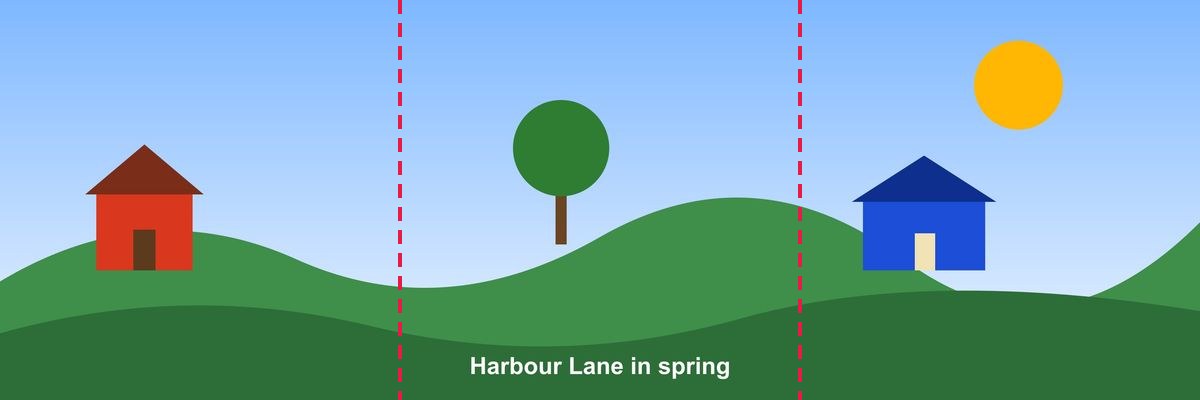
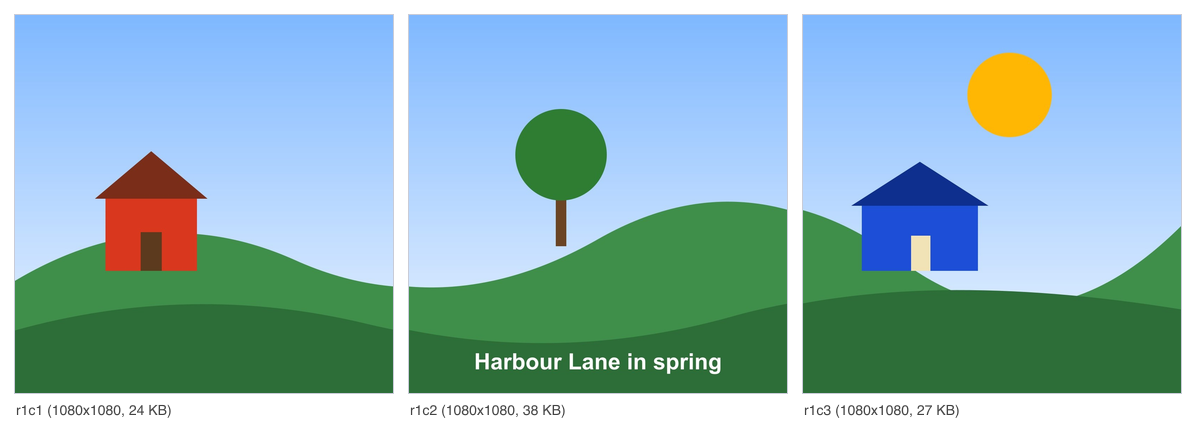
- In our test a generated 3240 x 1080 px JPEG of 85 KB split 1 x 3 gave a ZIP of 89 KB with three 1080 x 1080 px tiles, and the PNG tiles put back together equalled the original pixel for pixel; results vary with the picture.
- API: POST the picture to https://api.aiipworld.com/v1/image-jobs?op=image_edit&action=split with preset, rows and cols, or tile_width and tile_height, and poll GET /v1/jobs/:id.
- Free without an account: 30 pictures per day per visitor, no watermark. Signed in, each job costs 1 credit, plus 1 credit for each started 5 MB of result beyond the first 5 MB (100 free credits every month).
- Files are deleted automatically: 10 minutes after conversion without an account, 1 day with a free account.
How it works
- Upload one picture. Check the file type limits listed below the tool.
- Choose "Into a grid of rows and columns" or "Into tiles of a fixed size".
- Pick a quick choice or enter your own values. Check the tile count, the tile size and the cut lines on the preview.
- Choose the format and quality for the tiles, then run the split.
- Download the ZIP and open the picture file for each tile.
Example output
Input: JPEG, 3240 x 1080 px, 85 KB (the dashed lines are the cuts)
Output: ZIP of 89 KB with 3 tiles of 1080 x 1080 px
How to use Image Splitter
Use this splitter picture tool to cut one picture into several picture files. The page shows the number of tiles, the size of a tile, and cut lines drawn on a preview of your picture before you run the job. Check those lines first. If the page shows a warning, the choice is not valid, so change it before you run the split.
When the job ends, you get one ZIP with one picture file per tile. The result panel shows the number of tiles, the rows and columns, and the size of the first tile. The ZIP is the only result, and its download link is short-lived, so save it when it is ready.
Split into a grid of rows and columns
Pick a quick choice such as 2 x 2 or 3 x 3, or type your own Rows and Columns, each from 1 to 20. "Rows x columns" means rows first. A 1 x 3 split is one row of three tiles side by side, and a 3 x 1 split is three rows stacked. Rows run from top to bottom, and columns run from left to right.
The split must make at least 2 tiles. A split into more columns than the picture has pixels is refused. The shape of a tile follows the picture and the grid. In our test, a 3240 x 1080 px landscape split 1 x 3 gave three JPG tiles of 1080 x 1080 px.
- 1 x 3: one row, three columns, side by side.
- 3 x 1: three rows, one column, stacked.
Instagram grid maker: a 1 x 3 carousel and a 3 x 3 grid
Use this page as an instagram grid maker for a carousel or a photo-grid post. For a carousel, choose 1 x 3 on a wide picture. For a 3 x 3 grid, choose 3 x 3 on a square picture. In our test, a 1080 x 1080 px picture split 3 x 3 gave nine tiles of 360 x 360 px, named r1c1 to r3c3.
For a 3 x 3 grid, our tool suggests posting the nine tiles in reverse order: r3c3 first and r1c1 last. This is our tool's hint, not a promise about how any app shows grids. The tiles keep the shape of your picture. If you want square tiles from a wider picture, crop it to a square first with the Crop PNG tool.
Image Splitter: split into tiles of a fixed size
Choose "Into tiles of a fixed size", then enter Tile width (px) and Tile height (px). Each value can be from 1 to 65,535. If you fill in only one, the other side is the whole picture. Tiles start at the top-left corner.
Choose what happens at the edges. "Keep them as smaller tiles" is the default. "Leave them out" drops the partial tiles, and the panel says how many pixels were left out. The edge option works only with tile sizes, not with a grid. For example, a 1000 x 667 px picture with 400 x 400 px tiles and edges kept gives 6 tiles, four of them smaller.
When the picture does not divide evenly
In a grid, the tiles differ by 1 pixel at most, and no pixel is lost. In our test, a 1000 x 667 px picture split into 3 columns gave tiles 333, 333 and 334 px wide. The result panel tells you when this happens.
In fixed-size mode, the tiles at the right and bottom edge are smaller when the picture does not divide evenly. If you choose "Leave them out", the same 1000 x 667 px picture with 400 x 400 px tiles gives 2 tiles. The panel then shows 200 px on the right and 267 px at the bottom as left out.
Tile format, quality and transparency
Choose "Same as the original", PNG, JPEG or WebP for the tiles. "Same as the original" keeps JPEG as JPEG, and WebP and AVIF as WebP. It makes PNG for PNG, GIF, BMP and TIFF, so GIF, BMP and TIFF become PNG. The quality slider applies to JPEG and WebP and starts at 90. In our test, a 1080 x 1080 px picture split 2 x 2 as WebP at quality 80 gave a ZIP of 15 KB from a 40 KB JPEG.
PNG and WebP tiles keep transparency. JPEG has no transparency, so transparent areas are filled with the color you choose, which is white by default. The panel says how many tiles were filled. A tile that is completely opaque is saved without a transparency channel. The picture is turned upright by its rotation setting before the cut, and camera and location tags are not written to the tiles.
Animated pictures and big pictures
For an animated GIF or WebP, only the first frame is split. The panel and a note say so. In our test, a 4 frame GIF gave only the first frame. To get every frame, use the GIF to Frames tool first.
A large photo saved as PNG tiles can make a ZIP larger than 20 MB. The job then fails with an "output too large" message, and the credits are returned. In our test, a 3000 x 3000 px noisy JPEG of 4.0 MB split in 2 x 2 PNG tiles stopped because the tiles were already 24.2 MB, over the 20 MB limit. For photos, choose JPEG or WebP.
Limits: size, tiles and credits
The accepted types are PNG, JPG, WebP, AVIF, GIF, BMP and TIFF. SVG, PDF, HEIC and camera RAW files are not accepted. Without an account you can split up to 5 MB per picture, and signed-in users can split up to 10 MB. Each picture can be up to 16 MP (4096 x 4096), measured as width x height before it is opened. Each visitor without an account can run 30 jobs per day. One picture is used per job.
A split can make at most 400 tiles. A choice that would make more is refused before any work is done. Signed-in jobs cost 1 credit, plus 1 credit for each started 5 MB of the result beyond the first 5 MB. You get 100 free credits every month. Failed and timed-out jobs are refunded in full.
Split an image from code
Send a POST request to https://api.aiipworld.com/v1/image-jobs?op=image_edit&action=split. The body is the raw picture bytes, not JSON or multipart. Set Content-Type to image/png, image/jpeg, image/webp, image/gif, image/avif, image/bmp or image/tiff. The response is 202 with a job_id. Poll GET /v1/jobs/:id, and use download_url to get the ZIP. The link is short-lived. Authorize with Bearer <API key> or x-api-key.
Set the split with query parameters: preset, rows and cols, or tile_width and tile_height. The three ways cannot be combined. Other parameters are edge, format, quality and background. The page shows a ready cURL, Node and Python example below the tool, built from your settings. For the general API, see /docs/. Errors are 400 invalid_params, 413 file_too_large, 402 insufficient_credits and 429 rate limited.
Privacy: what happens to your file
You must have the right to use what you upload, as set out in our Acceptable Use Policy. Your file is sent to our server, and the uploaded file is used only to make the result. The working copy of the upload is deleted as soon as the job ends, whether it succeeds or fails. The result is deleted after 10 minutes in the free web tool, and no history is kept. Download links are short-lived.
The browser checks the file type before upload, and the server checks it again. The type is read from the first bytes of the file, not from its name. Anonymous use needs a human check from Cloudflare Turnstile. Signed-in users skip it and use credits. We do not add a watermark to your tiles.
Questions
Can I split an image for free?
Yes. You can split image online on this page without an account, up to 5 MB per picture and 30 jobs per day for each visitor. Signed-in users get 100 free credits every month.
How do I split an image into three parts for a carousel?
Choose the quick choice 1 x 3 on a wide picture. You get three tiles side by side, and the ZIP holds one picture file per tile. Crop the picture to a square first if you want square tiles.
How do I split an image into a 3 x 3 grid?
Choose 3 x 3 and run the split. You get nine tiles, named r1c1 to r3c3. For an instagram grid maker post, our tool suggests posting them in reverse order, starting with r3c3, but that is only our hint.
How do I split an image in half?
Choose 1 x 2 to get a left and a right half, or 2 x 1 to get a top and a bottom half. If the size is odd, the halves can differ by 1 pixel. An image split in half works like any other grid.
What do the file names r1c1 and r2c3 mean?
The letter r is the row and the letter c is the column, both counted from 1. Counting starts at the top-left. So r2c3 is the second row and the third column, and the extension is the tile format.
Why are my tiles not exactly the same size?
The picture does not always divide evenly. In a grid, tiles differ by 1 pixel at most, and in fixed-size mode the edge tiles are smaller. The result panel tells you which case applies.
Why do I get fewer tiles than I expected?
You may have chosen "Leave them out" for fixed-size tiles, which drops the partial edge tiles. The panel shows the pixels left out. A split that makes only one tile, or more columns than the picture has pixels, is refused.
Can I split a GIF?
Yes, but for an animated GIF only the first frame is split. To get every frame, use the GIF to Frames tool first. A static GIF is split as a picture, and its tiles are saved as PNG.
What is the maximum number of tiles?
A split can make at most 400 tiles. Grid rows and columns can each be from 1 to 20, so a 20 x 20 grid is 400 tiles.
Can I split an image in my own code?
Yes. Send the raw picture bytes to the image_edit split endpoint with the right Content-Type, then poll the job and download the ZIP. The page shows ready cURL, Node and Python examples built from your settings.
Need this in your app or in bulk?
This tool runs on the same platform as the API, so the same image is one HTTP request from your code. A free account includes 100 credits a month.